The Crisis of Self-Critique in Postmodernism: Fragmentation into Institutionalized Identity Ontologies
Postmodernism emerged in the late 20th century as a radical critique of modernism’s faith in progress, universal reason, and grand narratives. Thinkers like Jean-François Lyotard declared “incredulity toward metanarratives,” while Jacques Derrida’s deconstruction and Michel Foucault’s analyses of power/knowledge exposed how knowledge and representation were always entangled with domination. This skeptical, pluralistic stance celebrated fragmentation, irony, pastiche, and the dissolution of stable identities and meanings. In art, it manifested in appropriation, simulation, and the blurring of high and low culture.Yet postmodernism contained the seeds of its own crisis. Its core tools — relentless suspicion, relativism, and the rejection of foundational truths — proved difficult to contain once turned inward.
When critical theory’s own methods of interrogation were applied to postmodernism itself, the framework struggled to withstand the scrutiny. If all narratives are constructed and power-laden, then postmodernism’s celebration of difference and pluralism could itself be read as a new form of ideology, one that sometimes masked material inequalities or enabled the very consumerist late capitalism it claimed to critique (as Fredric Jameson famously argued).This self-reflexive pressure accelerated in the 1980s and 1990s through the rise of postcolonial theory, queer theory, critical race theory, and intersectional feminism. These approaches, deeply indebted to postmodern and post-structuralist thought, demanded greater attention to specific histories of oppression and the material conditions of identity. Postmodernism’s fluid, decentered subject began to appear insufficiently attentive to the concrete experiences of marginalized groups. Relativism, once liberating, risked undermining claims to justice by suggesting that all positions were equally constructed.The result was a fragmentation of the postmodern project. Broad cultural pluralism gave way to more tightly defined identity-based ontologies — frameworks in which identity (racial, gendered, sexual, national, or otherwise) became the primary lens for understanding both art and society.
In the art world, this shift was particularly visible. The playful, deconstructive strategies of early postmodernism were increasingly replaced by practices organized around identity categories. Curatorial programs, academic departments, funding bodies, and museums institutionalized these ontologies, creating dedicated spaces, discourses, and criteria for “identity art.” What began as a critique of essentialism sometimes hardened into new forms of essentialism or strategic essentialism, now backed by institutional authority.This institutionalization had paradoxical effects. On one hand, it brought long-excluded voices and histories into the center of cultural discourse, enriching the field immeasurably. On the other, it risked replacing one set of totalizing frameworks with another — now organized around competing identity claims rather than class, nation, or universal humanism.
The self-critique that postmodernism invited ultimately helped dismantle its own more open-ended pluralism, channeling critical energy into more bounded, administrable, and institutionally legible forms.In this sense, postmodernism did not simply “end.” It underwent an internal crisis of self-review that fragmented its legacy into the identity-centered paradigms that continue to shape much of contemporary cultural production and institutional life today.
The New Casual: How Relaxed Became the Dominant Aesthetic of Our Time
In the early 2020s, something subtle but profound shifted in how we present ourselves to the world. The suit-and-tie uniform of mid-century professionalism, the polished athleisure of the 2010s, even the ironic normcore of the 2000s have all given way to what we might call the New Casual — a pervasive, almost philosophical embrace of comfort, imperfection, and unstudied ease. This is not mere laziness or pandemic hangover. It is a cultural settlement: a response to economic precarity, digital exhaustion, climate anxiety, and a deep skepticism toward performative professionalism.The New Casual is visible everywhere. In corporate offices, hoodies and dad sneakers have become acceptable alongside tailored blazers. On red carpets and runways, celebrities appear in deliberately rumpled linen, oversized knits, and sneakers that cost more than a month’s rent. Even high fashion has absorbed the ethos — see the dominance of “quiet luxury” that still looks effortlessly thrown-together, or the continued success of brands like Lululemon, Patagonia, and Uniqlo that sell comfort as aspiration.
The uniform of Silicon Valley — hoodies, jeans, and Stan Smiths — has gone global.This aesthetic is not accidental. It reflects deeper structural changes. Remote and hybrid work dismantled the daily theater of “dressing for success.” The gig economy and cost-of-living crisis made expensive, high-maintenance clothing feel like an unaffordable performance. Social media, paradoxically, both accelerated and undermined traditional glamour; the perfectly filtered selfie gave way to “no-filter” authenticity and “get ready with me” videos that celebrate the mundane morning routine. The result is a culture that values “relatability” over aspiration.Philosophically, the New Casual aligns with broader shifts away from modernist rigidity and postmodern irony toward something more pragmatic and human. It echoes the metamodern oscillation between sincerity and knowingness: we dress casually not because we don’t care, but because we care about different things — mental health, sustainability, authenticity, and efficiency. The rejection of stiff collars and restrictive silhouettes is also a quiet rebellion against the body-shaming and class-signaling of previous eras. In a time of burnout and overstimulation, clothing that allows physical and psychological ease feels like resistance.Yet the New Casual is not without contradictions.
What began as democratic comfort has been rapidly commodified. “Elevated casual” is now a luxury category, with cashmere sweatpants costing hundreds of dollars. The aesthetic can mask inequality: the tech founder in hoodies is still a millionaire, while the service worker in the same outfit earns minimum wage. Moreover, the New Casual can flatten distinction. When everyone looks relaxed, subtle markers of status (brand, fit, fabric quality) become more important than ever. The truly wealthy can afford to look effortlessly casual; everyone else is simply casual.Culturally, the New Casual also signals a retreat from public performance. In previous generations, clothing was armor for navigating social hierarchies. Today’s default to leggings, oversized shirts, and baseball caps suggests a collective desire to opt out of that game — to move through the world with less armor and fewer expectations. This has liberating potential, particularly for women who historically bore the heaviest burden of appearance labor. It also risks a kind of cultural flattening, where the public square becomes visually monotonous and the signals of ambition or occasion are muted.
In art and media, the New Casual finds echoes in the rise of “sad girl” aesthetics, lo-fi aesthetics, and the celebration of the everyday. Artists and creators increasingly embrace imperfection, process, and domesticity rather than grand gestures. The influencer economy, once obsessed with aspirational perfection, has pivoted toward “day in the life” realism.The New Casual is, ultimately, a pragmatic adaptation to a world that feels increasingly unstable. In the face of economic volatility, climate crisis, political polarization, and technological acceleration, dressing (and living) with less rigidity offers a form of psychic insulation. It says: I am here, I am human, I am trying to navigate this mess without pretending otherwise.
Whether this aesthetic endures or becomes another fleeting trend remains to be seen. But for now, the New Casual feels less like a fashion choice and more like a cultural diagnosis — a collective acknowledgment that the old forms of presentation no longer fit the lives we actually lead. In embracing comfort and imperfection, we are not giving up on beauty or ambition. We are simply redefining them on terms that feel survivable in the present.
Painting in the Modern Era: From Giotto to Impressionism
The story of modern painting — understood as the long arc toward individual expression, optical truth, and eventual autonomy of the medium — begins not in the 19th century but in the early 14th century with Giotto di Bondone (c. 1267–1337). Giotto marks the decisive break from the flat, symbolic world of Byzantine and medieval art toward a recognizably modern concern with space, emotion, and the human figure in a believable environment. In works like the Scrovegni Chapel frescoes, Giotto introduced weight, volume, and dramatic narrative grounded in observed life. Figures occupy real space; light falls convincingly; emotions register on faces and in gesture. This was revolutionary.
Where earlier art served primarily as theological illustration, Giotto’s painting began to serve human experience. In this sense, he is the first modern painter.The Renaissance that followed built directly on Giotto’s foundation. Masaccio, Piero della Francesca, and Leonardo da Vinci refined linear perspective and anatomical accuracy, creating the illusion of a coherent, measurable world. Painting became a window onto reality, governed by scientific principles. The High Renaissance — Raphael, Michelangelo, Titian — added ideal beauty, psychological depth, and masterful color. By the 16th century, painting had achieved technical supremacy and cultural prestige. The medium was no longer merely devotional; it was a vehicle for humanist inquiry and princely power.The Baroque period (17th century) injected drama, movement, and emotional intensity. Caravaggio’s stark chiaroscuro and unidealized figures brought raw humanity to religious subjects. Rubens, Rembrandt, and Velázquez expanded the emotional and psychological range of painting. Rembrandt’s self-portraits and Velázquez’s Las Meninas reveal a growing self-consciousness about the act of painting itself — the artist as both observer and observed. These works already hint at modern concerns with perception and representation.
The 18th century saw painting turn toward elegance, wit, and social observation. Rococo artists like Watteau and Fragonard celebrated pleasure and fleeting sensation, while later in the century, neoclassicism (David) reacted with moral seriousness and archaeological precision. Yet underneath the stylistic shifts, painting continued to refine its ability to describe the visible world and probe human psychology.The real acceleration toward modernity came in the 19th century. Romanticism (Géricault, Delacroix, Turner) privileged emotion, the sublime, and the individual imagination over classical restraint. Landscape painting gained new prominence as artists like Constable and Turner treated nature as both subject and emotional mirror. The invention of photography in 1839 was a pivotal shock. Suddenly, painting’s traditional role as recorder of appearances was threatened. Instead of competing with the camera’s accuracy, painters began to explore what the medium could do better — color, touch, subjective experience.This tension reached its breaking point with Impressionism in the 1870s. Artists such as Claude Monet, Pierre-Auguste Renoir, Camille Pissarro, and Edgar Degas rejected the polished finish and historical/mythological subjects of the Salon. They painted en plein air, capturing transient effects of light and atmosphere with broken brushwork and pure color. Monet’s series paintings (haystacks, Rouen Cathedral, water lilies) revealed how perception itself is unstable and time-bound. Impressionism was not merely a new style; it was a philosophical pivot. Painting no longer aimed primarily to depict the world as it is, but to record how it appears to a specific observer at a specific moment. The canvas became a record of sensation rather than a window onto illusionistic space.
The Impressionist revolution opened the door to everything that followed. Post-Impressionists (Cézanne, Van Gogh, Gauguin) pushed further: Cézanne toward the underlying structure of vision, Van Gogh toward emotional expression through color, Gauguin toward symbolic and decorative freedom. By the early 20th century, these developments led directly to Fauvism, Cubism, Expressionism, and abstraction. The modern era of painting — autonomous, self-critical, concerned with its own formal language — had fully arrived.From Giotto’s first steps toward naturalism in the 14th century through the technical triumphs of the Renaissance and Baroque, the emotional expansiveness of Romanticism, and the optical and perceptual breakthroughs of Impressionism, Western painting followed a long trajectory. It moved from serving external truths (religion, power, nature) toward investigating internal ones (perception, emotion, the medium itself). Impressionism was the decisive pivot because it made the act of seeing — subjective, fleeting, and material — the true subject of art.
This long arc explains why modern and contemporary painting remains so rich and contested. Every subsequent movement, from Abstract Expressionism to today’s pluralistic practices, grapples with the questions Giotto first posed and the Impressionists radicalized: What can painting show us that no other medium can? How does the hand, the eye, and the material of paint create meaning in a world of mechanical reproduction and digital imagery?
Postmodernism in Art: From Duchamp to the Post-Human
Postmodernism in visual art did not arrive with a single manifesto but with a quiet, subversive gesture in 1917. Marcel Duchamp’s submission of a porcelain urinal titled Fountain to the Society of Independent Artists exhibition marked the decisive break. By signing it “R. Mutt” and presenting a mass-produced object as art, Duchamp challenged the very foundations of what art was supposed to be: unique, crafted by the artist’s hand, and aesthetically beautiful. The piece was rejected, but its implications were revolutionary. Art, Duchamp suggested, was not an object but a context, an idea, an institutional frame. The artist’s choice and the gallery’s validation mattered more than skill or beauty.
This was the birth of conceptual art and the opening salvo of postmodernism.Duchamp’s readymades and his alter ego Rrose Sélavy dismantled modernist notions of originality, authorship, and the autonomous artwork. His influence rippled through Dada and Surrealism, but postmodernism proper coalesced in the 1960s and 1970s amid broader cultural shifts: the decline of modernist faith in progress, the rise of consumer society, mass media, and post-structuralist theory. Artists like Andy Warhol turned the logic of mechanical reproduction into high art. Warhol’s Campbell’s Soup cans and Marilyn Monroe silkscreens embraced commodification rather than resisting it. Pop Art celebrated surface, repetition, and spectacle, declaring that there was no “outside” to consumer culture.The 1970s and 1980s saw postmodernism diversify.
Appropriation artists such as Sherrie Levine and Richard Prince re-photographed or re-painted existing images, questioning originality and authorship. Cindy Sherman’s Untitled Film Stills exposed the constructed nature of identity and femininity. In architecture and design, postmodernism rejected modernist purity in favor of historical quotation, pastiche, and playful eclecticism (think Robert Venturi’s “learning from Las Vegas”). Jean-François Lyotard’s The Postmodern Condition (1979) provided the theoretical backbone: incredulity toward metanarratives, the fragmentation of knowledge, and the rise of language games.By the 1980s, painting experienced a dramatic revival within postmodern terms. Neo-Expressionists like Julian Schnabel and Anselm Kiefer combined raw gesture with historical references and personal mythology. The Pictures Generation and appropriation strategies dominated critical discourse. Postmodernism in this period was characterized by irony, simulation (Jean Baudrillard), and the death of the author (Roland Barthes). Artists no longer sought to create new forms but to deconstruct, recycle, and critique existing ones. The line between high and low culture dissolved. Everything became grist for the mill.The 1990s brought a significant pivot. The exhibition Post Human, curated by Jeffrey Deitch at the FAE Musée d’Art Contemporain in Lausanne (1992, later traveling), crystallized the transition from classic postmodernism to something new. Featuring artists such as Cindy Sherman, Charles Ray, Matthew Barney, and Jeff Koons, the show explored the body in the age of biotechnology, plastic surgery, genetic engineering, and digital manipulation. It announced the arrival of the “post-human” condition: the body as mutable, constructed, and commodified. Traditional humanist notions of the natural, authentic self were declared obsolete. The exhibition captured the mood of the early 1990s — the end of the Cold War, the rise of the internet, and the acceleration of consumer culture and medical technology.Post Human marked the point where postmodernism’s emphasis on fragmentation and simulation merged with new technological realities. Irony and appropriation remained, but they were now joined by a fascination with the engineered body, identity as performance, and the blurring of human/machine boundaries. Artists like Orlan (with her surgical performances) and Stelarc pushed the logic further, treating the body as raw material. This post-human turn extended postmodern skepticism into the realm of biology and technology, setting the stage for 21st-century concerns with AI, genetic editing, and virtual identities.From Duchamp’s readymade to the Post Human exhibition, postmodernism in art followed a coherent arc. It began by questioning the artwork’s autonomy and the artist’s originality. It moved through strategies of appropriation, simulation, and institutional critique. It ended by dissolving the boundaries of the human subject itself. Along the way, it dismantled modernism’s faith in progress, originality, and medium specificity, replacing them with pluralism, relativism, and hybridity.Yet postmodernism was never a stable category. Its strength — radical skepticism and openness to difference — became, for some critics, its weakness: a reluctance to commit to new values or political projects beyond deconstruction. By the 1990s and 2000s, many artists and theorists were already moving “beyond” postmodernism toward renewed sincerity, relational aesthetics, or metamodern oscillation between irony and earnestness.Nevertheless, the legacy is profound. Duchamp’s gesture opened the door to conceptual art, installation, and the expanded field. The postmodern decades taught us to read images critically, to see identity as constructed, and to question grand narratives. Even today, when artists return to painting, craft, or beauty, they do so with a postmodern self-awareness. The Post Human exhibition, in retrospect, was less an endpoint than a bridge to our current era of fluid identities, digital bodies, and AI-assisted creation.Postmodernism did not kill art. It liberated it from rigid definitions and forced it to confront its own conditions of production and reception. From the urinal in 1917 to the engineered bodies of the 1990s, it taught us that art is always already entangled with power, technology, commerce, and the stories we tell about what it means to be human.
The Reappraisal of Modern Art Criticism: A Turning Point in 2006
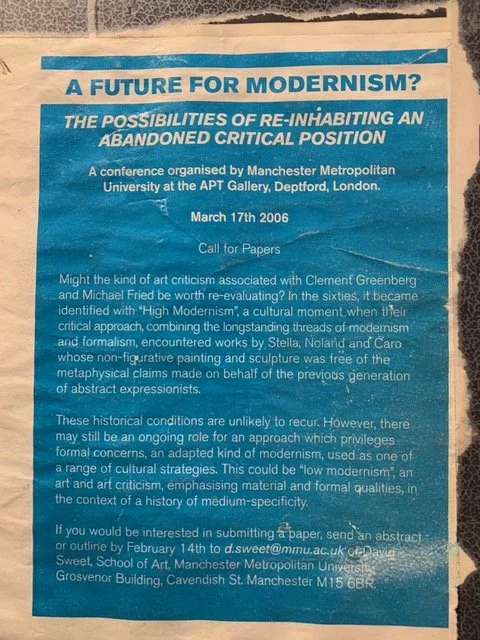
In 2006, a notable call for papers circulated in UK academic and art-world circles, seeking contributions to explore a reappraisal of modern art criticism. This initiative reflected a broader sense of crisis and opportunity in the field. Art criticism, once a vibrant, influential practice shaping public taste and artistic careers, appeared to be in decline. The rise of the internet, the professionalization of curating, the dominance of the global art market, and the fragmentation of theoretical discourse had all challenged the traditional role of the critic. The 2006 call was not an isolated event but part of a wider international conversation — including James Elkins’ influential The State of Art Criticism (2008) — that asked whether criticism could be renewed or whether it had become obsolete.To understand why such a reappraisal felt urgent in 2006, one must look back at the trajectory of modern art criticism. In the 18th and 19th centuries, critics like Diderot, Baudelaire, and Ruskin functioned as public intellectuals. They educated taste, defended new movements, and linked art to broader social and moral questions.
By the mid-20th century, figures such as Clement Greenberg and Harold Rosenberg wielded enormous power in New York, championing Abstract Expressionism and shaping the narrative of modernism as a progressive, formalist enterprise. Their writing was polemical, confident, and deeply invested in grand narratives of artistic quality and historical inevitability.Postmodernism in the 1970s and 1980s destabilized this authority. Deconstruction, postcolonial theory, feminism, and identity politics questioned the critic’s claim to objectivity. The “death of the author” (Barthes) and the rise of institutional critique shifted focus from individual genius to systems of power. Critics became more self-reflexive, but also more academic and specialized. The language of criticism grew dense with theory, often alienating general readers. Meanwhile, the explosion of biennials, art fairs, and global markets empowered curators, dealers, and collectors. The critic’s gatekeeping role diminished as artists gained direct access to audiences through the internet and social media.By the early 2000s, many sensed a crisis. Print journalism was contracting. Influential voices like Robert Hughes lamented the loss of rigorous, independent judgment. Younger writers operated in a fragmented landscape where “criticism” could mean anything from academic essays to blog posts, Instagram captions, or press releases. The 2006 UK call for papers sought to address this disarray. It invited scholars and practitioners to examine the history, methods, and future possibilities of modern art criticism. Was criticism still necessary? Could it regain public relevance without sacrificing intellectual depth? How should it respond to globalization, new media, and the rise of identity-based discourses?
The reappraisal that followed was rich and multifaceted. Some contributors argued for a return to evaluative judgment — the critic as arbiter of quality — while others embraced a more descriptive, contextual, or dialogic role. The influence of figures like Dave Hickey, who championed beauty and pleasure against academic solemnity, offered one path. Others looked to historical models: the engaged, literary criticism of Baudelaire or the polemical force of Greenberg. There was also growing interest in “art writing” as a creative practice in its own right, blurring the line between criticism and literature.From today’s perspective, the 2006 moment was transitional. The subsequent decade saw the rise of digital platforms that democratized criticism but also accelerated its commodification and ephemerality. Social media turned everyone into a critic, yet the attention economy favored hot takes over sustained analysis. At the same time, renewed interest in formalism, beauty, and craft (visible in movements sometimes labeled “metamodern” or post-internet) suggested that evaluative criticism was not dead but evolving. The institutionalization of identity politics and decolonial approaches brought new voices and perspectives, though sometimes at the cost of pluralism or aesthetic focus.The call for papers highlighted a key tension: modern art criticism had always been caught between description and prescription, objectivity and subjectivity, autonomy and engagement.
Postmodernism had exposed the illusions of neutrality, but it struggled to replace them with robust alternatives. The fragmentation that resulted — into academic specialization, market-driven promotion, activist critique, and personal essayistic writing — mirrored broader cultural fragmentation.Ultimately, the 2006 reappraisal did not produce a single new paradigm. Instead, it helped clear space for a more pluralistic, self-aware practice of criticism. In the years since, we have seen hybrid forms: critics who combine rigorous formalism with social analysis, writers who treat criticism as creative nonfiction, and platforms that blend scholarly depth with public accessibility. The crisis of criticism was real, but it was also productive. It forced the field to confront its assumptions and adapt to new conditions.Looking back, the 2006 call feels like a hinge moment. It marked the end of a certain confidence in modernist criticism and the beginning of a more humble, reflective era. Art criticism may never regain the cultural authority it held in the mid-20th century, but in its current dispersed, contested form, it remains essential. In a world saturated with images and algorithms, thoughtful, independent writing about art — whatever name we give it — helps us see more clearly, think more deeply, and resist the flattening effects of spectacle and commerce.
The reappraisal continues. The questions posed in 2006 — what is criticism for, who is it for, and how should it be practiced? — are as urgent today as they were then. The best criticism will always be the kind that balances rigor with responsiveness, judgment with openness, and historical awareness with contemporary relevance. In that sense, the 2006 call for papers was less a diagnosis of decline than an invitation to renewal.
Gary Michael Dault and David Foster Wallace: Parallel Voices in the Early Stirrings of a New Philosophy
In the early 1990s, a quiet but decisive shift began rippling through cultural criticism on both sides of the Atlantic and north of the border. Postmodernism’s reigning mode—irony, detachment, conceptual cleverness, and the dematerialization of the artwork—had begun to exhaust itself. What emerged was not a clean break but a tentative re-engagement with sincerity, materiality, affect, and craft. This “new philosophy,” later formalized as New Sincerity in literature and metamodernism in broader cultural theory, did not originate solely in the obvious capitals of New York or London. It took shape with equal force in Toronto, where art critic, poet, and painter Gary Michael Dault waged his own campaign against sterile conceptualism through the pages of the Globe and Mail. His work stands as the visual-arts counterpart to David Foster Wallace’s literary intervention.
David Foster Wallace’s 1993 essay “E Unibus Pluram: Television and U.S. Fiction” (published in the Review of Contemporary Fiction) remains the canonical diagnosis of late postmodern exhaustion. Wallace argued that television had absorbed and neutralized the subversive power of irony. What had once been a tool for critique had become the culture’s default register: cool detachment, knowing winks, and the perpetual deferral of genuine feeling. In a televisual world saturated with ads that already mocked their own claims, any art that relied on further irony simply flattered the audience’s cynicism without offering connection. Wallace called for writers willing to risk “sentimentality,” vulnerability, and earnest engagement—qualities that had become embarrassing under the postmodern regime. He envisioned a “post-postmodern” or “image-fiction” that could move beyond mere parody toward something more human and connective. This was not naive sincerity but a hard-won one, aware of its own risks.At roughly the same moment, and continuing through the decade, Gary Michael Dault performed an analogous labor in the visual arts from his Toronto base. As the author of the influential weekly “Gallery Going” column in the Globe and Mail (a platform that reached a broad national audience), Dault consistently championed painters who foregrounded texture, pigment, gesture, and unapologetic emotional presence over conceptual one-liners or ironic appropriation. He celebrated artists such as Michael Adamson for what later commentators have called “pigment-joy” and visceral materiality—the thick, labored impasto that insisted on the hand, the body, and the physical encounter with paint.
Dault’s own practice as a painter reinforced the point. His small, rapid works on humble cardboard (cereal boxes, book wrappings) are gestural, messy, and ecstatic—produced in minutes rather than labored over for conceptual effect. They embody a philosophy of direct, almost impatient engagement with material and motif. In a 2004 Globe and Mail review of the exhibition The Ironic Turn, Dault expressed a nuanced fatigue with irony as default mode, noting the “breathtaking single-mindedness” and “prodigious craftsmanship” he found more vital than detached deconstruction. Contemporary artists and writers have since read this piece as a quietly radical proto-metamodern document, written years before Timotheus Vermeulen and Robin van den Akker coined “metamodernism” in 2010. The simultaneity is striking. While Wallace was diagnosing television’s ironizing effects on American fiction from the Midwest and publishing in literary journals, Dault was using one of Canada’s most prestigious newspapers to defend the messy, sincere, labor-intensive object in Toronto’s galleries. Both recognized that heavy craft—whether Wallace’s encyclopedic, footnote-laden novels or Adamson’s impasto canvases—could serve as an antidote to digital or conceptual detachment. Both understood that the “new philosophy” required not the rejection of intelligence or play, but their recombination with sincerity and presence. Dault had studied with Northrop Frye and Marshall McLuhan in Toronto; his criticism carried a deep literary and media-theoretic sophistication that paralleled Wallace’s own philosophical range.This decentralized emergence matters. The formalizing of the shift away from high postmodern irony did not require waiting for New York gallery consensus or London’s YBA aftermath. In Toronto’s relatively intimate but intellectually serious art scene of the early-to-mid 1990s,
Dault’s weekly column created a sustained public argument for textured, emotionally transparent painting at the exact moment Wallace was making the parallel case in literature. Similar undercurrents were visible elsewhere—emerging painters in New York reacting against 1980s appropriation art, or British artists beginning to move beyond pure conceptual shock—but Toronto’s contribution, voiced through a major daily newspaper by a critic who was also a practicing poet and painter, was no less central.By the late 1990s, artists like Adamson (championed by Dault as early as 1997–99) were already working in what would later be recognized as a metamodern register: oscillating between irony and sincerity, concept and materiality, critique and belief. Dault’s paintings themselves—colorful, direct, often childlike in their immediacy yet sophisticated in their formal decisions—embody the same oscillation.
The “new philosophy” was never a single manifesto issued from one metropolis. It was a structure of feeling that crystallized wherever critics and artists grew tired of irony’s prison and began risking the unfashionable virtues of presence, craft, and human connection.In this light, Gary Michael Dault and David Foster Wallace appear not as isolated figures but as parallel diagnosticians and prophets. One worked primarily with words in the United States; the other with both words and paint in Canada. Together they helped articulate, in the early 1990s, the cultural turn that would later be named New Sincerity and metamodernism—a turn whose full implications we are still living out. Toronto mattered as much as New York or London because the exhaustion with postmodern detachment was not a parochial problem; it was a widespread condition whose remedies could be discovered, and publicly argued for, wherever serious critics chose to look at actual paintings and demand more from them than cleverness.
Riopelle, Pollock, Hofmann, and the European Roots of Abstraction
The standard 20th-century MoMA narrative—championed by critics like Clement Greenberg—cast Abstract Expressionism (AbEx) as a triumphant American invention. Jackson Pollock became its emblem: the cowboy-genius who, through raw individualism and drip technique, wrested the avant-garde from a war-ravaged Europe and planted it firmly in New York. This story served Cold War cultural diplomacy well, positioning the U.S. as the new center of Western art. Yet it downplays how deeply European techniques, philosophies, and artists shaped the movement. Jean-Paul Riopelle’s early all-over abstractions and Hans Hofmann’s “push-pull” methods reveal a far more transatlantic story. Abstraction was never purely American; it was a European inheritance adapted and intensified on both sides of the Atlantic. Jean-Paul Riopelle (1923–2002), the Montreal-born painter associated with the Quebec Automatistes, developed densely all-over compositions in the mid-to-late 1940s—precisely when Pollock was transitioning toward his signature style. Riopelle signed the landmark Refus Global manifesto in 1948 alongside Paul-Émile Borduas, rejecting academic figuration in favor of spontaneous, instinctive creation rooted in Surrealist automatism.
Works like Hochelaga (1947) distribute color touches and drips across the entire surface with little regard for traditional pictorial hierarchy or focal points. The result is a vibrant, non-hierarchical field that anticipates the “all-over” effect Greenberg would later celebrate in Pollock. Riopelle moved to Paris in 1947, immersing himself in Surrealist circles (he exhibited with André Breton) and Lyrical Abstraction. His technique evolved rapidly into thick, mosaic-like impasto—small, tesserae-like strokes of vibrant color built into energetic, boundary-less fields. By the early 1950s, pieces such as those in his major Paris exhibitions displayed the same rejection of center and edge that defined mature Pollock. While Pollock’s breakthrough drips gained fame with works like Full Fathom Five (1947) and the poured canvases of 1948–50, Riopelle had already established a parallel practice rooted in European automatism and direct Surrealist influence. His all-over fields were not mere decoration; they embodied a philosophy of freedom and instinctive gesture that paralleled, and in some cases preceded, the New York School’s celebrated breakthroughs. Pollock himself was no isolated American original. His drip technique owed a clear debt to Hans Hofmann, the German-born painter and teacher who emigrated to the U.S. in 1932. Hofmann’s “push-pull” theory—dynamic spatial tension created by advancing and receding colors and forms—emphasized the flat canvas as an arena of energetic forces rather than illusionistic depth. Hofmann experimented with poured and dripped paint as early as the mid-1940s (e.g., works like The Wind, c. 1944). Pollock attended Hofmann’s classes and lectures in the 1930s–40s; Lee Krasner, Pollock’s partner, studied directly with him. Historians have long debated priority—some early accounts suggested Hofmann’s pours inspired Pollock—but the influence flowed both ways through shared circles and a common interest in Surrealist spontaneity (notably André Masson’s poured lines). Pollock’s famous 1947–50 drips represent a radical extension of Hofmann’s ideas: using the entire body in motion to activate the canvas surface as an all-over energy field. This European lineage runs deeper.
Many key AbEx figures were European emigrés or drew heavily from European sources: Arshile Gorky (Armenian-born, Surrealist-influenced), Willem de Kooning (Dutch), Hofmann himself. Surrealism’s emphasis on the unconscious—brought to New York by wartime exiles like Breton, Masson, and Matta—provided the philosophical and technical foundation for gestural abstraction. Automatism, poured paint, and psychic improvisation were European imports refined in America. Riopelle’s Paris-based practice in the late 1940s shows the same impulses flourishing independently in Europe, producing results comparable to Pollock’s without the American mythos.MoMA’s institutional narrative, amplified in exhibitions and catalogs of the 1950s–60s, deliberately emphasized American exceptionalism. Abstract Expressionism was marketed as a homegrown triumph of individualism and freedom, contrasting with Soviet Socialist Realism. This framing minimized European precedents to claim cultural supremacy. Greenberg’s formalist criticism reinforced it by focusing on medium-specific purity and flatness, sidelining the messy, transatlantic dialogues of influence. Riopelle, working in Paris and later with Joan Mitchell (a second-generation AbEx painter), was often categorized separately—as Canadian or European “Lyrical Abstraction”—rather than integrated into the AbEx canon. Yet his dense, tactile all-over fields and Hofmann-Pollock’s shared techniques expose the fiction of a purely American breakthrough. The broader implication is clear: 20th-century abstraction was a cosmopolitan dialogue, not a New York monopoly.
European traditions of color, gesture, and spontaneity—from Monet’s late water lilies (which Riopelle explicitly homage in monumental works) to Hofmann’s pedagogical innovations and Surrealist automatism—provided the soil. Pollock’s genius lay in scaling and mythologizing these elements with American scale and bravado, but the roots were transatlantic. Riopelle’s prior and parallel achievements in Europe and Canada demonstrate that the “all-over” sensibility was an international current, not an American invention.Recognizing this does not diminish Pollock or the New York School; it enriches the story. Abstraction’s power came from cross-pollination—European theory meeting American ambition amid postwar upheaval. The MoMA view, shaped by Cold War politics, preferred a simpler tale of U.S. triumph. A more accurate history acknowledges Riopelle’s early all-over experiments, Hofmann’s foundational techniques, and the European DNA running through the entire movement. In doing so, we see mid-century abstraction not as a national victory but as a shared modernist achievement—one far more European in its origins and international in its realization than the 20th-century canon cared to admit.
Jack Bush and the Quiet Revival of Abstraction Amid Pop and Minimalism
In the 1960s, the art world seemed to declare abstraction dead. Pop Art burst onto the scene with Andy Warhol’s soup cans, Roy Lichtenstein’s comic-book blow-ups, and James Rosenquist’s billboard fragments, embracing consumerism, irony, and recognizable imagery. Minimalism followed, with Donald Judd’s boxes, Frank Stella’s shaped canvases, and Carl Andre’s floor pieces reducing art to industrial materials and geometric purity. Both movements rejected the emotional, gestural excesses of Abstract Expressionism. Critics and curators proclaimed the end of painting’s dominance; sculpture, concept, and spectacle took center stage. Into this climate stepped Jack Bush (1909–1977), a Toronto painter whose radiant, color-saturated abstractions offered a stubborn and joyful counter-narrative. Far from fading into obscurity, Bush helped sustain and revitalize a vibrant, lyrical strain of abstraction—Color Field and post-painterly approaches—that emphasized emotion, optical pleasure, and pure painting at a moment when such values appeared passé. Bush’s path was unlikely for a revolutionary.
Born in Toronto, he trained in Montreal and spent decades as a successful commercial illustrator and figurative/landscape painter influenced by the Group of Seven. Like many mid-century Canadian artists, he operated in a conservative environment where abstraction struggled for acceptance. In 1953–54, he joined Painters Eleven, a loose collective of Toronto artists (including William Ronald, Harold Town, and others) dedicated to exhibiting and promoting abstract art against the dominance of landscape tradition. The group’s name was pragmatic—they were eleven painters who exhibited together starting in 1954 at Roberts Gallery. Their goal was simple but radical in Canada: to assert that abstraction was a living language, not a foreign import or passing fad. Bush’s early abstract works from this period retained some gestural energy rooted in Automatism and Abstract Expressionism, with loose brushwork and moody tones. A pivotal personal moment accelerated his commitment. In 1947, struggling with anxiety, Bush’s doctor encouraged him to paint freely from inner feelings without preconceived subjects. This therapeutic advice aligned with broader modernist currents—Surrealist automatism and the expressive freedom of the New York School. By the late 1950s, Bush had largely abandoned figuration. His shift coincided with international attention: Painters Eleven exhibited in New York, and Bush began traveling there, absorbing developments while forging his own voice.The real transformation came in the 1960s through mentorship by Clement Greenberg, the powerful American critic who had championed Abstract Expressionism but later promoted “Post-Painterly Abstraction.” Greenberg visited Toronto, critiqued Bush’s work, and urged him to refine his palette toward clarity, thinness, and optical purity. He advised Bush to emulate the stained, soaked effects of his works on paper when painting on canvas. Bush listened. In 1966 he switched decisively to acrylics, which allowed thinner, more luminous applications. Works like Dazzle Red (1965), This Time Yellow (1968), and later pieces such as April Blue (1970) feature bold, flat areas of pure color—often in vertical bands, central columns, or floating shapes—against expansive fields. These paintings sing with Matisse-like joy and the direct color impact of Helen Frankenthaler or Morris Louis, yet retain a distinctly personal warmth. Bush compared his approach to jazz: improvisational, emotional, celebratory. This was abstraction’s revival in action.
While Pop Art ironized consumer culture and Minimalism stripped art to essence (often coolly intellectual or anti-expressive), Bush doubled down on color as pure emotional vehicle. His large-scale canvases from the mid-1960s onward radiate optimism and sensory pleasure. Forms are simplified—stripes, lozenges, or irregular blocks—but never rigidly geometric. Color relationships create vibration and depth without illusionism: a bright red “sash” against deep green, or yellow columns pushing against blue grounds. These works feel jubilant, almost hedonistic, at a time when much art was detached or critical. Bush achieved international success precisely then: solo exhibitions in New York (starting 1962 on Madison Avenue), representation at the São Paulo Biennial (1967), and acclaim from critics who saw him as a leading Color Field voice alongside Kenneth Noland and Jules Olitski. He retired from commercial illustration in 1968 to paint full-time, producing some of his strongest work in the 1970s until his death in 1977. Bush’s persistence mattered for several reasons. First, he demonstrated that abstraction could evolve beyond the macho gesturalism of 1950s AbEx into something more open, luminous, and accessible. His Color Field approach—large areas of unmodulated color, stained or thinly painted—offered an alternative to both Pop’s representational return and Minimalism’s objecthood. It kept painting alive as a medium of optical and emotional experience. Second, in Canada, where the art scene was smaller and more conservative, Bush (along with Painters Eleven) helped professionalize and internationalize abstraction. Toronto in the 1960s was no New York; Bush’s success abroad validated local practice and inspired younger artists. His work bridged generations: rooted in mid-century modernism yet forward-looking in its embrace of acrylics and flatness.Critically, Bush avoided the dead ends that critics sometimes associated with late AbEx. His paintings never felt nostalgic or overworked. Influenced by Matisse’s color orchestration and American Color Field, they prioritized “the feeling of a subject” over literal depiction. As he matured, composition grew bolder and simpler—often a central motif or edge-aligned bands—allowing color to dominate. This restraint amid vibrancy countered Minimalism’s austerity while avoiding Pop’s cynicism. Greenberg called him a “supreme colorist,” placing him alongside Noland. Exhibitions in the 1970s and posthumous retrospectives confirmed his stature. Today, major institutions like the Art Gallery of Ontario and MFA Boston highlight his radiant canvases as highlights of mid-century abstraction. Bush did not single-handedly “defeat” Pop or Minimalism—those movements expanded art’s possibilities and reflected their era. But he proved abstraction’s resilience. While Pop celebrated (and critiqued) mass culture and Minimalism explored systems and materials, Bush reminded viewers that painting could still deliver unalloyed visual joy and emotional resonance. His late works from the 1960s–70s feel like a defiant affirmation: color as life force, painting as celebration. In an age of irony and reduction, he kept the door open for lyrical, color-driven abstraction.
The legacy extends beyond his lifetime. Bush influenced Canadian art’s embrace of modernism and helped sustain Color Field and Lyrical Abstraction internationally. His story counters the narrative of abstraction’s obsolescence in the 1960s. Pop and Minimalism challenged it, but artists like Bush—working steadily, refining under mentorship, and trusting color’s power—ensured its survival and evolution. In today’s pluralistic art world, where painting has resurged in many forms, Bush’s radiant fields look prescient: optimistic, sensory, and enduring. He showed that abstraction need not retreat into obscurity; it could dazzle, refresh, and endure.
How the Art World Changed Between 2015 and 2020
The years 2015 to 2020 marked a period of profound transformation in the global art world, characterized by digitization, market volatility, social reckoning, and the acceleration of trends that had been simmering for decades. This half-decade bridged the post-2008 recovery and the COVID-19 pandemic, which acted as a catalyst for changes already underway. Auction houses set records, social media reshaped visibility and sales, digital art gained traction, and institutions faced demands for greater diversity and accountability. While the traditional gallery system and physical fairs remained central, the foundations for a more fragmented, online, and socially conscious ecosystem were laid.
By 2020, the art world was more accessible yet more unequal, more global yet more polarized. The art market experienced significant fluctuations but overall resilience and growth in certain segments. According to Art Basel and UBS reports, the global art market reached around $64.1 billion in sales in 2019, down slightly from previous peaks, before contracting sharply in 2020 due to lockdowns. Auction sales in 2019 showed caution amid geopolitical tensions (Brexit, U.S.-China trade wars), with fewer masterpieces surfacing. However, contemporary art—especially by living artists—continued to command high prices. Post-war and contemporary sales at houses like Christie’s and Sotheby’s benefited from a shift toward “blue-chip” modern and contemporary works as safer investments. The rise of mega-galleries (Gagosian, Hauser & Wirth, David Zwirner) consolidated power, while smaller galleries struggled with rising rents in cities like New York and London. Online sales began their ascent even before the pandemic, with platforms and viewing rooms experimenting with digital previews. The 2020 downturn (global sales dropping roughly 22-25% in some estimates) forced rapid adaptation, with online auctions and virtual fairs becoming normalized. This period solidified the “winner-take-most” dynamic, where top artists and galleries captured disproportionate value. Technology and social media fundamentally altered how art was discovered, consumed, and sold. Instagram, launched in 2010 but exploding in influence during this period, became the primary platform for artists and galleries. By the mid-2010s, a new generation of artists built careers through direct-to-audience strategies, bypassing traditional gatekeepers. “Instagram artists” like those in street art or figurative painting gained massive followings, leading to gallery representation and sales. Galleries used the platform for behind-the-scenes content, exhibition announcements, and direct collector engagement.
This democratization lowered barriers but also intensified pressures for constant content creation and “virality.” Artists could cultivate personal brands, but algorithms favored certain aesthetics—polished, colorful, shareable works. The period also saw early experiments with digital art. While NFTs exploded in 2021, their foundations were laid earlier: crypto art communities on platforms like SuperRare (2018) and the conceptual groundwork for blockchain-based ownership emerged around 2017. Artists explored VR/AR installations and online exhibitions, foreshadowing the metaverse hype. The pandemic in 2020 accelerated everything: art fairs went virtual (Art Basel Online Viewing Rooms), museums offered digital tours, and sales shifted online, reaching record highs for digital channels (estimated $12.4 billion globally in some reports for 2020). Institutional and social changes reflected broader cultural shifts. The #MeToo movement (peaking 2017–2018) exposed power imbalances in galleries and museums, leading to resignations, policy reviews, and greater scrutiny of artist behavior and workplace culture. Representation of women and artists of color improved incrementally, with exhibitions highlighting overlooked figures. The 2020 murder of George Floyd and subsequent Black Lives Matter protests prompted museums and galleries to reassess collections, programming, and staffing. Institutions issued statements on racial justice, deaccessioned or contextualized controversial works, and committed (at least rhetorically) to diversity. Biennials and major exhibitions increasingly addressed identity, migration, climate, and politics. The 2019 Venice Biennale (“May You Live in Interesting Times”) and Documenta 14 (2017) exemplified a turn toward global, non-Western perspectives. At the same time, market pressures persisted: ultra-contemporary artists (often young, social-media savvy) saw speculative booms, with auction records for figures like Amoako Boafo or Christina Quarles. This created tensions between social justice rhetoric and commercial realities.
Geopolitical and economic factors shaped the landscape. Brexit (2016 referendum, ongoing uncertainty) affected London’s status as an art hub, with some galleries and collectors relocating or hedging bets. The Trump presidency (2017–2021) influenced U.S. cultural funding debates and introduced tariffs that impacted imports. China’s growing market influence continued, with domestic collectors driving demand for both Western and Chinese contemporary art, though crackdowns on capital outflows created volatility. The middle market (works under $50,000 or so) faced challenges from online competition and gallery consolidations, while the ultra-high end thrived on trophies. Art advisors and private sales grew in importance as collectors sought discretion amid public scrutiny. By 2020, the COVID-19 pandemic crystallized many changes. Physical fairs and openings halted, forcing a digital pivot. Online viewing rooms (OVRs) became standard, auction houses thrived with remote bidding, and artists turned to studios for new production while engaging audiences via social media. Museums closed, accelerating debates about relevance and digital futures. The period ended with uncertainty but also innovation: the art world emerged more hybrid, with physical and virtual coexisting. Speculation in contemporary works continued, setting the stage for the 2021 NFT boom.Overall, 2015–2020 transformed the art world from a relatively closed, event-driven ecosystem into a more fragmented, digitally mediated one. Social media democratized access but commodified attention.
Market concentration favored the top tier, while calls for equity challenged elitism. Technology, from Instagram to early blockchain experiments, expanded possibilities for creation and ownership. The pandemic was a shock but not the sole driver—it amplified pre-existing trends. Abstraction, figuration, installation, and performance all adapted, but the biggest shift was structural: art became more visible, more market-oriented, and more entangled with broader cultural and technological currents. The era laid the groundwork for today’s hybrid, global, and contested art world—one where boundaries between artist, influencer, collector, and speculator continue to blur.
How the Language Describing Painting Changed from 2020 to 2025 in Major Art Magazines and Museum Catalogs
The years 2020 to 2025 witnessed a marked evolution in the critical language surrounding painting. The COVID-19 pandemic, social reckonings, technological acceleration, and a resurgent interest in materiality reshaped how critics, curators, and catalog writers discussed the medium. Once dominated by postmodern terms like “appropriation,” “deconstruction,” and “simulation,” descriptions shifted toward embodiment, affect, ecology, identity, and hybridity. Major publications such as Artforum, Frieze, Art in America, and museum catalogs from institutions like MoMA, Tate, and the Whitney increasingly emphasized painting’s tactile, healing, and communal qualities, reflecting broader cultural changes. This transformation was not uniform but reflected a collective move away from ironic detachment toward sincere engagement with the painted surface.
The pandemic year 2020 acted as a catalyst. With galleries closed and exhibitions virtual, critics noted a renewed appreciation for painting’s physicality. In Artforum and Frieze, writers described canvases as “anchors” or “tactile antidotes” to digital isolation. Museum catalogs for postponed or reimagined shows highlighted “material presence” and “embodied gesture.” Terms like “gesture,” “impasto,” and “surface tension” gained prominence, evoking the artist’s body and the viewer’s sensory response. This language countered the dematerialized discourse of the 2010s, when digital and conceptual practices often overshadowed traditional media. Painting was reframed as resistant and restorative—a medium that “insists on slowness” in a fast-scrolling world. Catalogs for artists like Julie Mehretu or Mark Bradford emphasized process as ritual or resistance, linking brushwork to personal and collective trauma. By 2021–2022, as exhibitions resumed, the language incorporated post-pandemic themes of healing and community. Frieze reviews spoke of paintings that “hold space” or “offer solace,” while museum wall texts and catalogs used phrases like “emotional resonance” and “affective power.” Figuration’s resurgence—seen in artists like Salman Toor, Danielle Mckinney, or Amoako Boafo—brought narrative-driven descriptions.
Critics moved beyond formal analysis to explore storytelling, identity, and lived experience. Terms such as “queer figuration,” “Black interiority,” or “diasporic memory” became commonplace in Art in America and Whitney or Tate catalogs. This reflected institutional pushes for diversity following 2020’s racial justice protests. Painting was no longer primarily “about painting” (a 20th-century modernist holdover) but a vehicle for social commentary and personal testimony. Even abstract works were described through affective or ecological lenses: “vibrational fields” or “embodied landscapes” rather than pure opticality. Materiality emerged as a dominant motif across 2022–2024. In the wake of supply-chain disruptions and a broader cultural interest in craft, writers celebrated “tactility,” “pigment joy,” and “textural abundance.” Artforumessays on artists like Oscar Murillo or Laura Owens highlighted how paint “accumulates” or “breathes,” evoking labor and presence. Museum catalogs for exhibitions like “The Living End” (tracing painting and technology) or retrospectives of Cecily Brown discussed “carnal” or “visceral” surfaces, contrasting them with digital flatness. Language borrowed from phenomenology and new materialism: paintings “entangle” viewer and object, or “enfold” histories. This shift marked a departure from earlier decades’ emphasis on critique or de-skilling toward affirmative celebration of skill, sensuality, and endurance. Hybrid practices—painting incorporating digital prints, textiles, or found objects—prompted terms like “expanded painting” or “post-digital gesture,” acknowledging technology’s influence without abandoning the medium. By 2024–2025, ecological and decolonial frameworks further inflected descriptions. Catalogs for biennials or thematic shows invoked “extractive histories” or “more-than-human entanglements,” linking paint (often petroleum-derived) to climate concerns. Writers in Frieze described works as “regenerative” or “in dialogue with the land.” Identity language became more nuanced and intersectional, moving beyond tokenism to deeper explorations of positionality. Terms like “autofiction,” “speculative fabulation,” or “embodied archives” appeared in discussions of figurative painters addressing migration, gender, or queerness. At the same time, a counter-current celebrated “pure painting” or “joyful abstraction” in response to politicized fatigue. Reviews balanced sincerity with criticality, using accessible yet theoretically informed prose. Major catalogs adopted more narrative structures, weaving artist biography with formal analysis and cultural context, making them more reader-friendly for broader audiences.
This evolution mirrors larger societal shifts. The pandemic fostered introspection and a hunger for physical connection; social media amplified diverse voices while pressuring institutions toward equity; digital saturation prompted a “return to the hand.” Critics moved from the detached, theory-heavy style of the 2000s–2010s toward language that is more embodied, affective, and contextual. Painting descriptions became less about declaring the medium’s “death” or “triumph” and more about its ongoing vitality in a hybrid world. Terms once marginal—“care,” “pleasure,” “healing,” “entanglement”—entered the mainstream.Challenges remain. Market pressures can reduce complex works to “investment” language, while performative inclusivity risks superficiality. Nevertheless, the 2020–2025 period enriched critical vocabulary, making descriptions of painting more attuned to lived experience, ecology, and multiplicity. In museum catalogs and magazines, painting is no longer an isolated formal exercise but a porous, responsive practice embedded in the world’s complexities. This change signals not a rejection of rigor but an expansion of what rigor can encompass—sensory, ethical, and relational. As exhibitions and publications from this era show, the language of painting has become more alive, reflecting a medium—and an art world—that continues to adapt and endure.